Introduction

Finite element analysis (FEA) is a modeling based mechanical simulation analytic strategy used to provide direct visual illustration of the mechanical properties (i.e. stress and strain) of a complex mechanical systems1,2. Over the past decades, FEA has been extensively applied across various field, including mechanical engineering, material science, and clinical medicine3,4,5,6,7. In recent years, its applications in paleontology have grown significantly8,9,10. Biomechanical analysis using FEA, based on the microtomography profile of fossil material, provides valuable insights into the function and ecological role of extinct taxa, contributing to the resolution of key evolutionary questions11,12.

Unlike the well-preserved skeletal specimen of extant species, fossilized specimens often contain surrounding rock matrix. These impurities, when filling out the intertrabecular space of the cancellous bone, would bear stress upon load exertion, which significantly distort the mechanical performance of model used in FEA. To address this, paleologist commonly use segregation through thresholding to minimize such interference13. By selecting the voxels within a specific range of gray values in CT scans, regions corresponding to bone density can usually be successfully isolated. However, in fossil materials primarily composed of cancellous bone, the delicacy of the internal trabecular structure and the relatively low-density contrast between the fossil and the surrounding matrix leaves manual segmentation as one of the few reliable methods for achieving precise removal of extraneous material14,15,16. While this approach is accurate, it is extremely labor-intensive and time-consuming, which makes erasing every trace of rock from the fossil trabeculae impossible to achieve. Recently, an increasing number of recent studies have adopted deep learning as a more efficient strategy for fossil segmentation, achieving highly accurate isolation of the specimen from the external rock that it embedded in17,18. However, none of the previous study has attempt to perform segmentation of fossil trabeculae using this novel method.

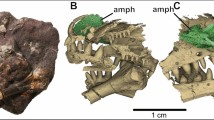
In this study, we utilize the femoral specimen of Jeholosaurus (Fig. 1a, b, c) from the Early Cretaceous Jehol Group of Western Liaoning, China to explore the feasibility of conducting FEA on CT-reconstructed fossil model processed by deep learning-aided segmentation. By further testing the enhancement of the stress distribution of segmented FE model in its capacity of modeling the fossil trabecular architecture, we evaluate whether the resulted biomechanical simulation better reflects the biological reality of the fossil during its in vivo state following the removal of surrounding rock matrix.

Fig. 1
figure 1

Photos of Jeholosaurus femoral fossil (IVPP V 15939) in coronal view (a) and cross-sectional views (b from proximal end; c from distal end). The segmented femoral fossil models before (d) and after (e) fissure fixation. The scale bar is 2 cm.

Result

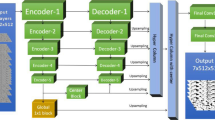
Under 2.5D approach, a stack of 2D slices centered around the three manually segmented training frames (Fig. 2, top row) were input to the U-net architecture and trained by Segmentation Wizard Workflow in Dragonfly 3D World. After the initial round of training, the model demonstrated strong performance in separating fossil from rock and air, as the dice coefficient (air + rock) that quantifies the overlap between the model-predicted segmentation and the manually annotated ground truth reaches 0.9573 (values approaching 0.95 indicating near-perfect overlap). However, trabecular bone was not clearly distinguished from cortical bone based on human interpretation, particularly at the transition zones (Fig. 3a, left). To address this, two manually segmented frames (Fig. 3a, right), which the model had not accurately predicted during the first round, were incorporated for additional training iterations.